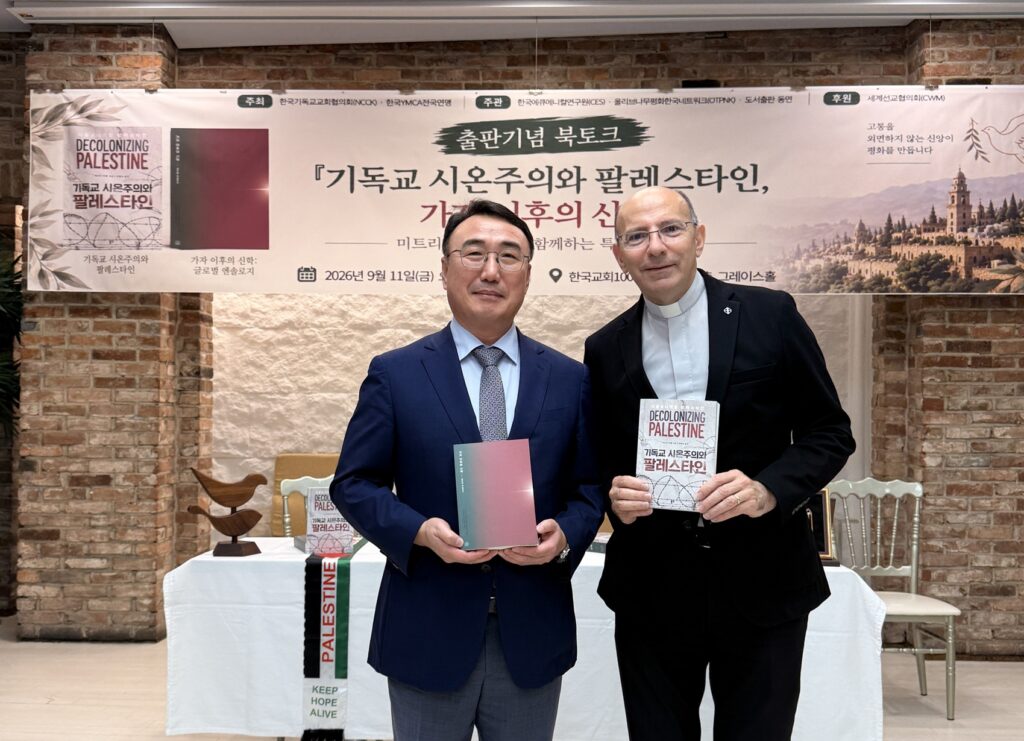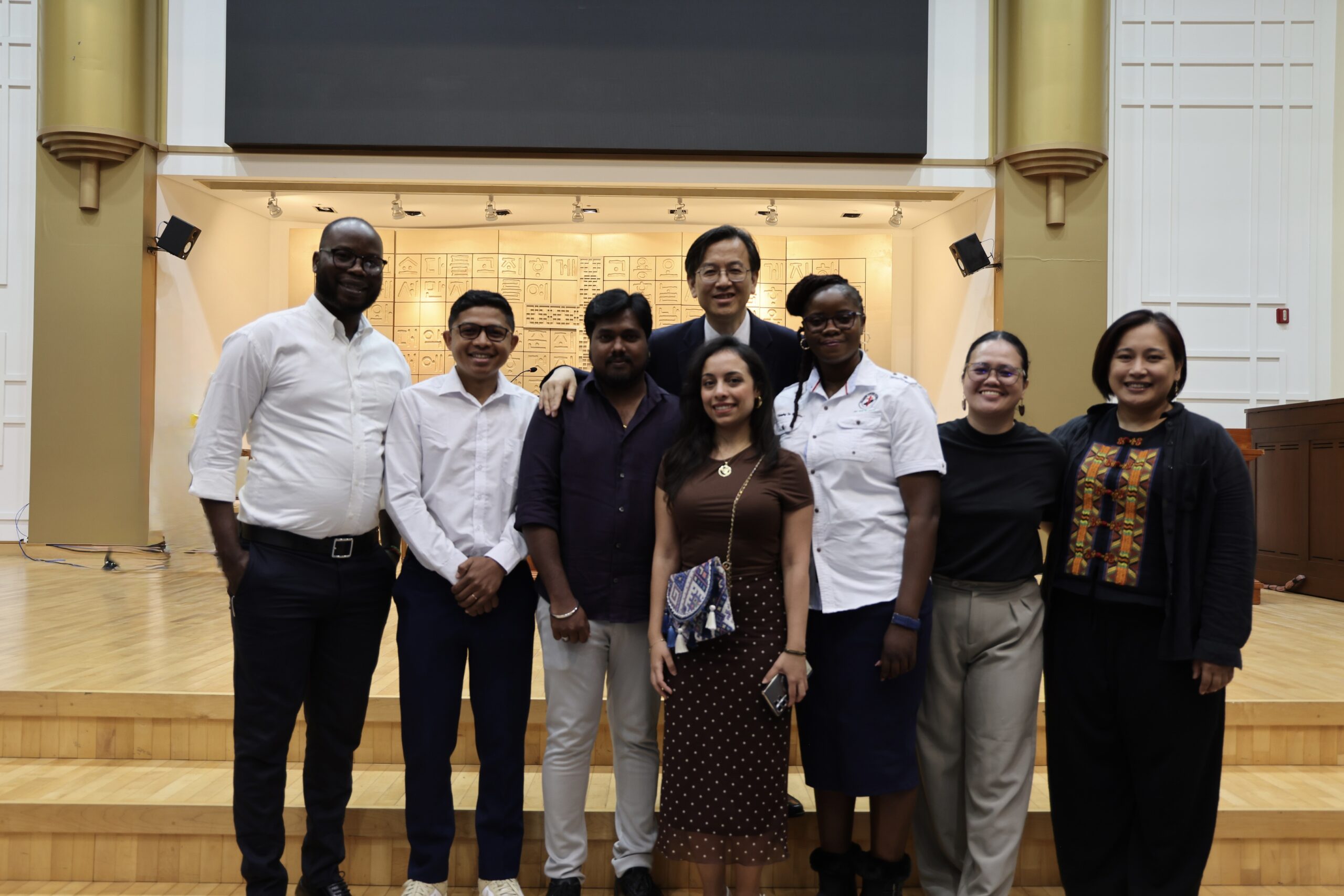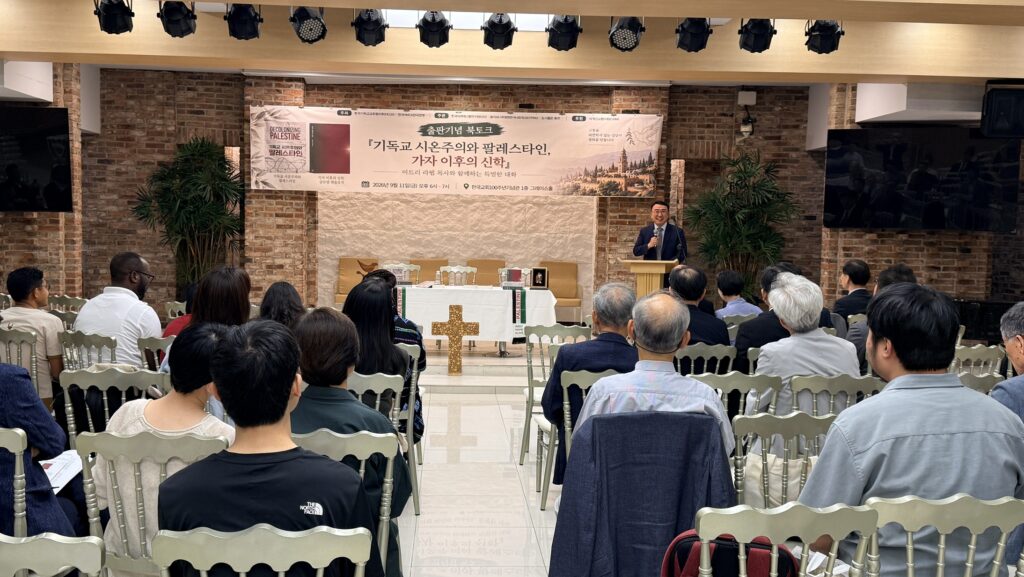
The Korean editions of Decolonising Palestine: The Land, the People, the Bible by Mitri Raheb and Theology after Gaza: A Global Anthology, edited by Mitri Raheb and Graham McGeoch, were launched on 11 September at the Korean Church Centennial Memorial Building in Seoul, South Korea.
The event brought together around 70 theologians, ecumenists, youth leaders, and pastors. It was hosted by the National Council of Churches in Korea and the National Council of YMCAs of Korea, and organised by the Korean Centre for Ecumenical Studies. The two Korean editions were published with support from the Council for World Mission (CWM).
In his welcome address, CWM General Secretary Rev. Dr Jooseop Keum described Decolonising Palestine as more than an academic work.
“Decolonising Palestine is more than a scholarly study. It is a prophetic intervention by a Palestinian Christian theologian whose reflection is formed in the concrete realities of land, history, dispossession, resistance, and hope,” Keum said.
Reflecting on Theology after Gaza, Keum highlighted its global and interreligious character.
“Theology after Gaza gathers a global and interreligious range of voices, including Christian, Jewish, and Muslim scholars. It refuses to treat Gaza as a distant or isolated tragedy. Instead, it places Gaza within the longer history of settler colonialism, colonial power, racism, and the dehumanising underside of modernity,” he said.
Keum added that the two books complement one another by examining both the structures that sustain dispossession and the theological responsibilities that arise in the aftermath of violence.
“Decolonising Palestine helps us uncover the historical and theological structures that make dispossession appear normal or even sacred. Theology after Gaza compels us to consider what faithful speech and action are possible after those structures have produced catastrophic consequences.”
He also expressed hope that the Korean translations would reach beyond academic institutions.
“These Korean translations will be read widely, not only in theological seminaries and universities, but also in churches, Bible study groups, ecumenical organisations, peace movements, and among younger generations searching for an honest and courageous faith,” Keum said.
In his greetings, Raheb described the Korean publication as an opportunity for deeper dialogue across different historical and political contexts.
“The fact that this book now speaks in Korean is not a mere linguistic expansion; it is an invitation to a shared conversation across geographies shaped by histories of division, colonisation, resistance, and hope,” Raheb said.
“I hope that this Korean edition will contribute to deeper conversations in churches, universities, and civil society and encourage new forms of engagement between Korean and Palestinian experiences.”
The launch continued with a dialogue session featuring Raheb and the two Korean translators, Prof. Byung Joon Chung and Prof. Seung Bum Kim. The session was followed by questions and discussion with the audience.