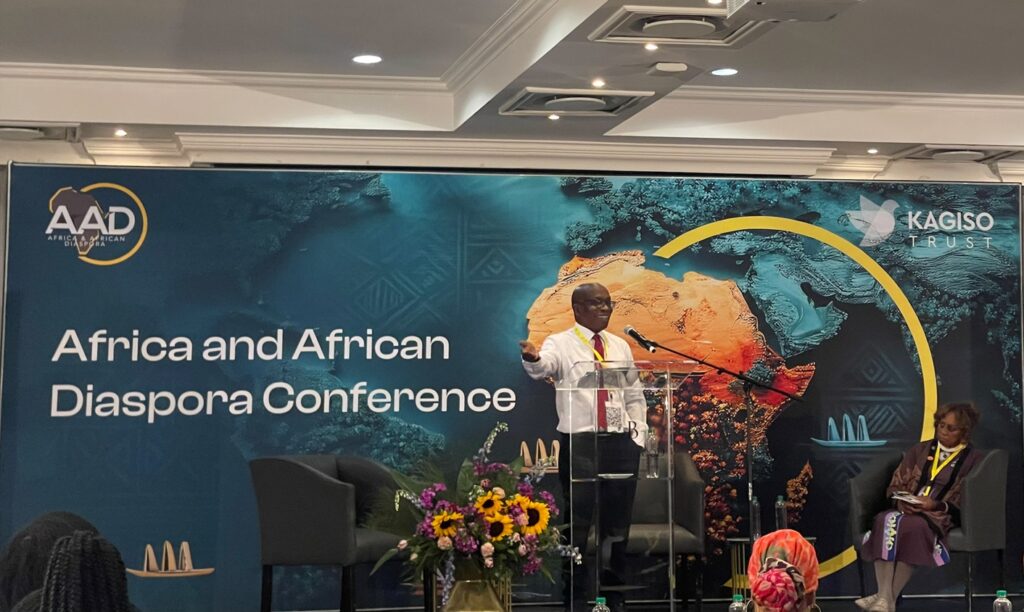
The Council for World Mission (CWM) reaffirmed its commitment to confronting the legacies of slavery and colonialism, calling on churches to move beyond historical acknowledgement towards meaningful action for reparative justice.
The reaffirmation formed part of wider conversations at the Africa and African Diaspora Conference (AAD), held from 26-30 October in Johannesburg. The gatherings explored economic justice, African agency, and stronger partnerships between Africa and its diaspora.
Reparative justice: an expression of the African struggle for liberation
Reflecting on the theme, “Return to Africa,” Chairperson of The Onesimus Project (TOP) Core Group Rev. Dr Roderick Hewitt challenged Christian institutions to confront their historical complicity in slavery and colonial oppression while strengthening solidarity between Africa and its diaspora.
Drawing on the contributions of Pan-African leaders and cultural figures such as Martin Luther King Jr and Bob Marley, Hewitt traced reparative justice to the wider struggle for African dignity, self-determination, and liberation.
He also challenged participants to reconsider conventional historical narratives about Africa and the diaspora, including the contributions of Africans from the Caribbean to the development of Christian institutions in parts of West Africa.
Re-examining these historical narratives, Hewitt argued, is essential to understanding the interconnectedness of African peoples and challenging accounts that diminish African agency and contribution.
“The church must acknowledge its own historical complicity!”
Hewitt noted that, although the Christian gospel proclaims human dignity and abundant life, Christian institutions have historically accommodated systems that justify slavery, racial hierarchy, and colonial exploitation.
He stressed that reparative justice must extend beyond financial compensation to embrace repentance, restored dignity, historical accountability, and transformed relationships.
Reflecting on CWM’s own journey, Hewitt acknowledged its historical links with the London Missionary Society and outlined the organisation’s efforts to confront this complex legacy.
TOP as a four-pronged movement
Hewitt outlined four interconnected priorities guiding TOP: addressing the legacies of slavery, confronting modern slavery and racial injustice, advancing education for empowerment and liberation, and promoting transformative ecumenism.
He also reflected on three important lessons emerging from CWM’s experience: neutrality is not an option in the face of dehumanisation; Christian discipleship demands active resistance to oppression; and those who experience oppression must have agency in determining and shaping their own liberation.
Through its reparative justice work via TOP and ecumenical gatherings such as the AAD, CWM continues to challenge the wider African Christian landscape to participate in building a world in which human dignity is respected, historical wrongs are confronted, and relationships between Africa and its diaspora are strengthened through justice, solidarity, and shared hope.