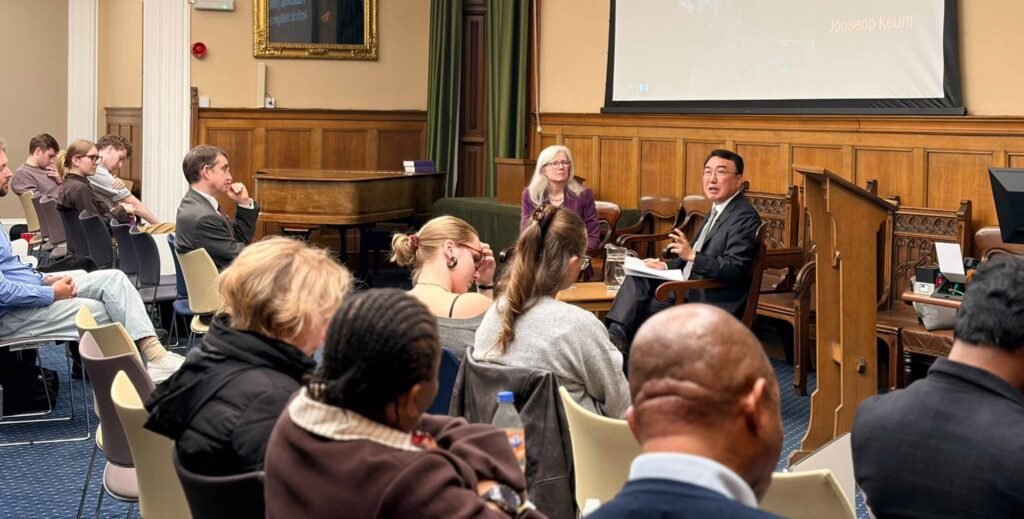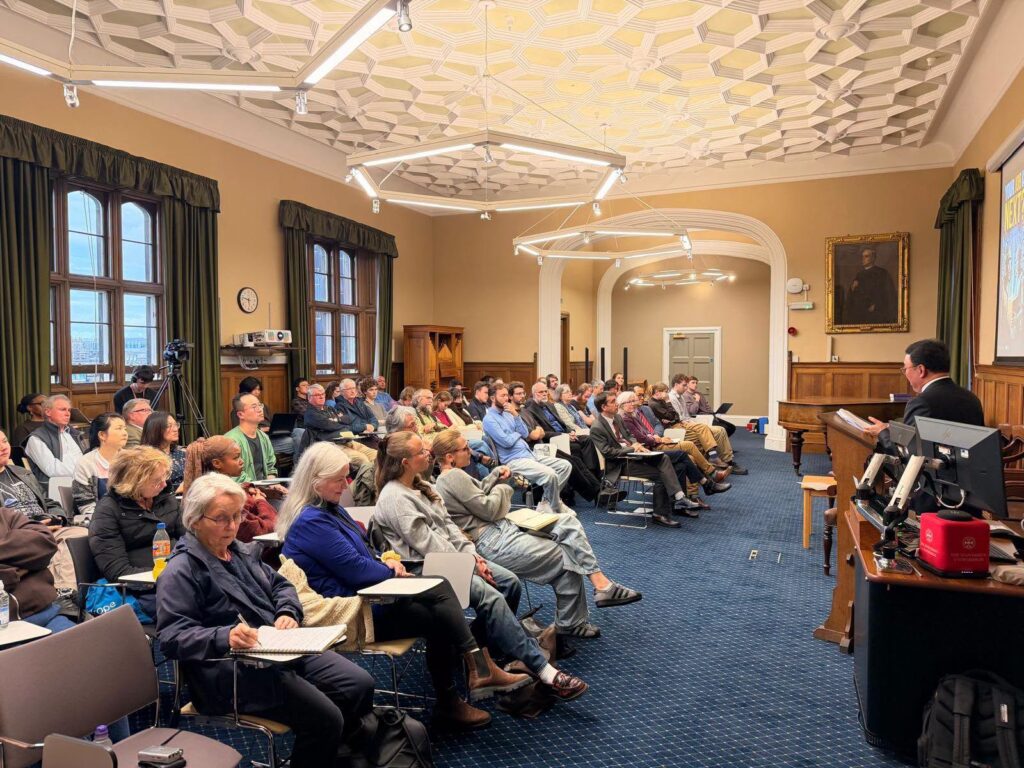
Council for World Mission (CWM) General Secretary Rev. Dr Jooseop Keum delivered three Cunningham Lectures at New College, University of Edinburgh, on 5, 7, and 8 October.
Under the theme, “What Does It Mean to Be Human? Slavery, Artificial Intelligence, Creation, and Mission,” Keum explored the interconnected challenges of technological transformation, decolonisation, and ecological destruction, calling for radical discipleship in response to the life-denying forces shaping today’s world.
Established in 1862, the Cunningham Lectures are the oldest endowed lecture series at New College. Founded in memory of Rev. Dr William Cunningham (1805–1861), the second principal of New College, the series has brought together distinguished theologians for more than 160 years to address major theological questions, including Christian doctrine, church history, human rights, global Christianity, and mission.
Mission as (trans)humanisation
In his first lecture on 5 October, “Mission as (Trans)Humanisation: Artificial Intelligence and Surplus Humanity,” Keum examined how artificial intelligence and automation are reshaping human life while deepening inequalities, particularly in the Global South.
He warned that technological systems driven by efficiency and profit risk reducing people to disposable labour and further marginalising vulnerable communities.
Affirming that every human being bears the image of God, Imago Dei, and possesses intrinsic dignity, Keum challenged churches to resist dehumanising structures and nurture life-affirming communities.
“No one is surplus. No one is disposable,” Keum said, calling for radical discipleship grounded in God’s mission of liberation and transformation.
Decolonising mission
In his second lecture on 7 October, “Saint Onesimus, Saint Quamina: Legacies of Slavery and Decolonising Mission,” Keum explored the contradictory history of Christian mission through the experiences of two formerly enslaved Christian leaders, Onesimus of the early church and Quamina of 19th-century Demerara.
He examined how Christian institutions could proclaim salvation while participating in systems of slavery and colonial domination.
Keum outlined six priorities for decolonising mission, including confronting continuing colonial struggles, pursuing economic and ecological justice, challenging Western theological dominance, and ensuring accountability in the redistribution of power and resources.
He stressed that constitutional reforms and apologies alone are insufficient, calling instead for genuine transformation in relationships between churches so that “mission from everywhere to everywhere” becomes a lived reality of equality, justice, and mutual partnership.
Creation at the heart of mission
In his final lecture on 8 October, “Creation at the Heart of Mission: Transformative Spirituality Beyond Anthropocentrism,” Keum challenged the human-centred worldview that treats the natural world primarily as a resource for exploitation.
He argued that slavery, colonialism, technological domination, and ecological destruction share a common logic of domination that divides life between the powerful and the expendable.
Christian mission, he suggested, must move beyond human supremacy towards a spirituality grounded in the interconnectedness of all creation.
Keum emphasised that authentic humanity is not achieved by overcoming every human limitation through technology, but through love, relationships, responsibility, vulnerability, and communion with God and creation.
The lectures received appreciative responses for their engagement with contemporary theological and missional challenges.
Dr Alexander Chow commended Keum for combining academic rigour with practical experience of mission. He said the lectures offered important world Christianity perspectives “to challenge and inspire the next generation of theological scholars and practitioners”.
Rev. David Coleman welcomed Keum’s “fully creation-integrated approach” to mission, particularly his challenge to human supremacy and the separation of humanity from the wider creation. He also highlighted the connections between historical struggles against slavery and contemporary efforts to confront the injustices of the fossil fuel era.