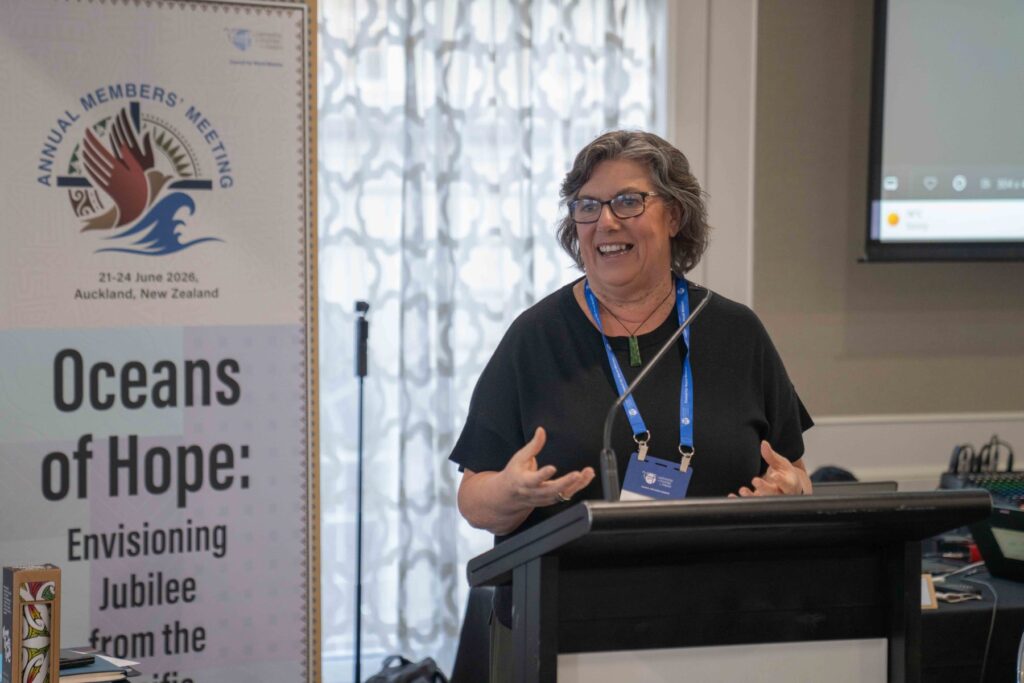
As the Council for World Mission (CWM) Annual Members’ Meeting (AMM) convenes in Auckland, Presbyterian Church of Aotearoa New Zealand (PCANZ) Assembly Executive Secretary Rev. Erin Pendreigh highlighted the importance of partnership, local mission, and community flourishing in a rapidly changing world.
Pendreigh, who began her role in February 2026, is leading the host church for this year’s AMM. Although she had been in office only a week when the invitation to host the AMM was received, she saw it as an opportunity to strengthen PCANZ’s relationship with CWM and the wider global fellowship.
“I would say yes, even though I did not totally understand, because that is what being a good partner is,” she said.
Having participated in several CWM programmes in recent years, Pendreigh said the gathering is providing an opportunity to deepen relationships across the global partnership and to gain a broader understanding of CWM’s mission and ministry.
“It is all about being a good partner church,” she said.
As Assembly Executive Secretary, Pendreigh sees one of her key responsibilities as reconnecting a denomination that became increasingly localised following the COVID-19 pandemic.
“We are better together than all little separate churches,” she said.
She explained that PCANZ supports local congregations by easing administrative and ministerial burdens, enabling them to focus more fully on the mission to which God has called them. Her role also involves connecting churches with resources, opportunities, and partnerships that can strengthen their ministries.
Reflecting on the context of Aotearoa New Zealand, Pendreigh named growing challenges such as homelessness, loneliness, domestic violence, poverty, and widening social inequality. Churches are also navigating an increasingly secular society in which Christianity is often viewed with scepticism.
Yet she believes local congregations continue to play vital roles within their communities.
“People do not want church, but they want what the church has,” she said. “They want the comfort and security that the church and local congregations can provide.”
Across the country, PCANZ congregations remain actively engaged in community outreach through food banks, pastoral care, and support groups. Pendreigh said the church remains committed to maintaining a visible, meaningful presence within local communities.
“Jesus came to seek and save the lost,” she said. “If we do that, perhaps we will be an example of the kingdom of God even here on earth.”
Rather than focusing primarily on large-scale programmes, PCANZ has increasingly embraced collaborative movements that encourage participation, discipleship, and missional engagement. These include Forge Aotearoa, which equips Christians to explore new expressions of mission, and Common Grace, which encourages churches to engage thoughtfully in wider societal conversations.
The denomination has also strengthened its commitment to creation care through partnerships with Eco Church NZ and initiatives such as the A Rocha Aotearoa New Zealand project, reflecting its conviction that environmental stewardship is an integral dimension of Christian mission.
Looking ahead, Pendreigh hopes to deepen the partnership between PCANZ and CWM by encouraging greater reflection and follow-up after international mission experiences. She believes this can help participants share their learning more effectively and identify new ways for the church to contribute to the global fellowship.
“I want us to understand our voice and how we can contribute as a partner church,” she said.
As CWM journeys towards Jubilee 2027 and Assembly 2028, Pendreigh sees partnership, accompaniment, and local mission as essential to the flourishing of both churches and communities.