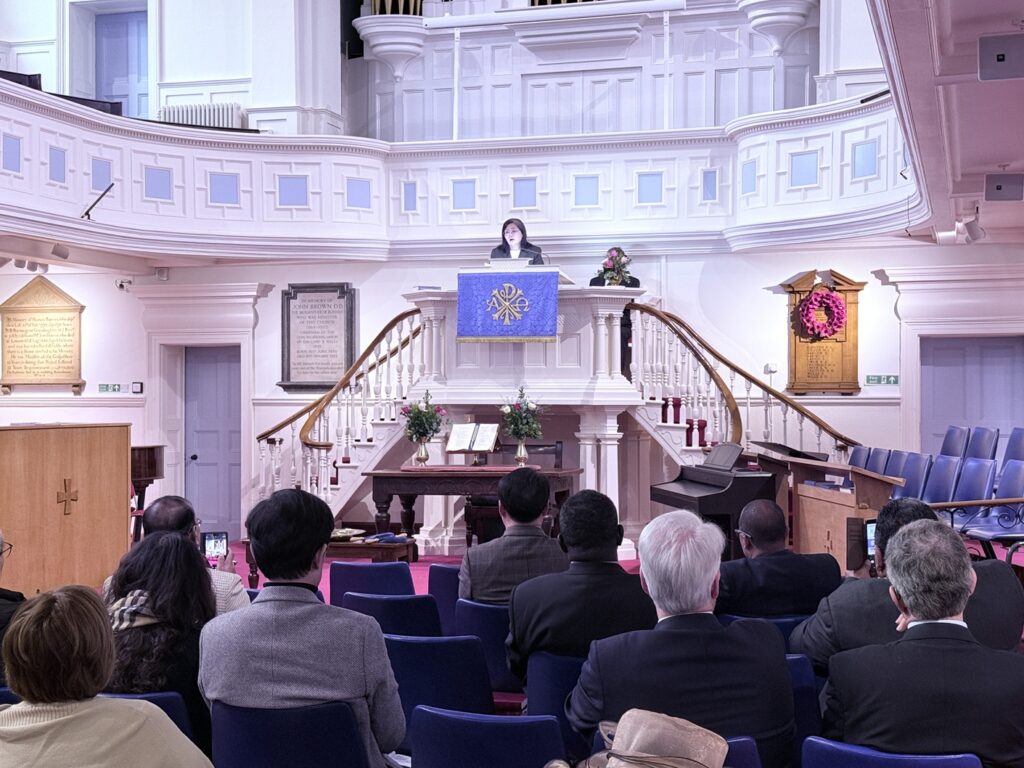
The Council for World Mission (CWM) Board of Directors convened from 16–18 November in the United Kingdom, beginning their meeting with a Sunday worship service at the Bunyan Meeting Church in Bedford, founded in 1650. The church’s deep roots in radical dissent and the pursuit of freedom continue to shape its witness and mission today.
Bunyan Meeting Church stands as a symbol of courage and conviction in the face of oppression. During the 16th and 17th centuries, the Church of England faced strong opposition from Christians seeking more freedom in worship. These nonconformists, including Baptists and Congregationalists, were barred from public life, education, and public office, and many suffered imprisonment or execution for their faith. Among them was John Bunyan, who spent more than 12 years in prison in Bedford for preaching without a state licence.
“Gathering in this historic Bunyan Meeting Church, we are all reminded of the powerful legacy of nonconformist witness and the courageous pursuit of religious freedom,” said CWM Moderator Dr Natalie Lin in her greeting. “That same spirit continues to inspire our shared calling to resist life-denying systems and affirm life-flourishing communities around the world today.”
During the service, CWM General Secretary Rev. Dr Jooseop Keum presented a CWM plaque to Rev. Christopher Damp, minister of Bunyan Meeting Church, in appreciation for the congregation’s warm hospitality.
Remembering the roots of dissent
The church’s story is inseparable from the turbulent religious landscape of 17th-century England. During Cromwell’s Commonwealth (1649–1660), independent congregations flourished as believers sought a freer, simpler form of worship. Yet this freedom ended with the Restoration of King Charles II, whose Act of Uniformity (1662) reimposed strict conformity to the rites of the Book of Common Prayer.
More than 2,000 clergymen refused to comply, resulting in the Great Ejection of 1662. Bunyan’s refusal to conform led to his imprisonment from 1660 to 1672, and again briefly in 1677, for preaching outside state control.
A pilgrim’s enduring journey
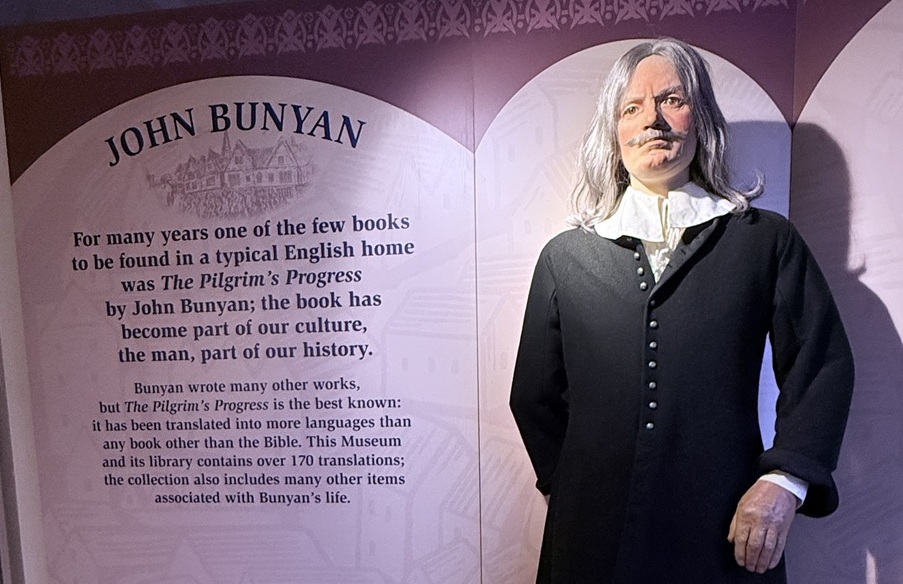
After the service, the Board visited the John Bunyan Museum, located next to Bunyan Meeting Church. Born in 1628 in Elstow, Bunyan joined an independent church that later became Bunyan Meeting Free Church, which continues to worship on the same site today.
While imprisoned, Bunyan began writing The Pilgrim’s Progress (1678), a spiritual allegory that has since sold millions of copies and been translated into around 300 languages. The museum now holds editions in over 170 languages, along with several of Bunyan’s almost 60 published works.
The upcoming Bunyan 400 celebrations in 2028 will mark the 400th anniversary of Bunyan’s birth and the 350th anniversary of The Pilgrim’s Progress (bunyan400.org.uk).
“Why does something that happened 400 years ago matter to us today?” asked Rev. Dr Janet Wootton, chair of the Anniversary Steering Committee. “Because the themes of John Bunyan’s life—freedom of speech, faith under pressure, and the transformative power of education—remain profoundly relevant in our world, where censorship and persecution still silence many voices.”